Guides
How to Measure Yourself at Home (for Quotes & Fittings)
A step-by-step guide to measuring your waist, hips, inseam and sleeve length at home in Singapore — what to send us on WhatsApp for a fast alteration quote, and why the tape measure at your fitting is always the one that counts.
The single fastest way to get an alteration quote in Singapore is to send a photo and a few honest numbers over WhatsApp before you book a fitting. You do not need a tailor's precision or a dressmaker's tape technique — a soft measuring tape, a flat surface, and five minutes is enough to get a real price range back quickly, rather than waiting until you can visit the studio.
This guide walks through measuring yourself at home for the most common alteration requests — pants, dresses, shirts and skirts — and exactly what to send us for a quick estimate. Nothing here replaces your fitting; it just means the fitting starts from a quote instead of a guess.
What You'll Need
- A soft fabric tape measure. A rigid DIY tape bends the wrong way around a body and gives an inaccurate reading — any sewing or craft shop, or an online retailer, will have one.
- A mirror, or a second pair of hands. Some measurements — waist, hips, chest — are easy to take on yourself in a mirror. Others, like inseam or sleeve length, are far more accurate with someone else holding the tape while you stand naturally.
- A garment that already fits the way you want. If a measurement is awkward to take on your own body, measuring an existing piece of clothing flat on a table — one that already sits the way you're hoping the new one will — often gives a cleaner number than wrestling with a tape measure in a mirror.
The Core Measurements, Step by Step
Waist
Wrap the tape around the narrowest part of your natural waist, usually just above the belly button, keeping it level all the way around and snug without pulling it tight. A tape that dips lower at the back than the front is the most common self-measuring mistake — check it in a side mirror if you can.
Hips
Measure around the fullest part of your hips and seat, roughly 20cm below the waist for most people. Keep the tape parallel to the floor, not angled, and stand with your feet together.
Inseam (Pants & Jeans Length)
Wear the trousers with the shoes you'd actually pair them with, stand naturally, and measure straight down the inside leg seam from the crotch to where you want the hem to land. This one is much easier with a second person holding the tape — bending down to read it yourself tends to shift your posture and throw the number off by a centimetre or two. No helper? Lay a pair that already fits well flat on a table and measure the inside seam directly instead.
Outseam & Rise
Outseam runs from the waistband down the outside leg to the hem — useful for tapering or length checks on trousers and jeans. Rise is the distance from the crotch seam straight up to the top of the waistband, measured on a garment laid flat; it tells us whether a waist adjustment or a taper is the more appropriate fix.
Sleeve Length (Shirts & Dresses)
With your arm relaxed at your side and slightly bent at the elbow, measure from the shoulder seam — where the sleeve meets the shoulder — over the elbow to the wrist bone. As with inseam, it's often easier to measure a shirt that already fits well, laid flat from shoulder seam to cuff edge.
Shoulder Width & Bust / Chest
Shoulder width runs seam to seam across the back, best measured on a garment laid flat rather than on yourself. Bust or chest is measured around the fullest part, tape level front and back, worn over the kind of underlayer you'd normally wear with the piece.
Garment Length (Dresses & Skirts)
Measure from where the waistband or bust seam sits down to where you'd like the hem to fall — usually easiest done standing in front of a mirror with the garment on, marking the spot with a pin before measuring down to it.
| Garment | Measurements that matter most | Read more |
|---|---|---|
| Pants & jeans | Waist, inseam, outseam, rise | Pants alterations |
| Dresses | Bust, waist, garment length | Dress alterations |
| Shirts | Chest, shoulder width, sleeve length | Shirt alterations |
| Skirts | Waist, hip, garment length | Skirt alterations |
What to Send Us for a Quick Quote
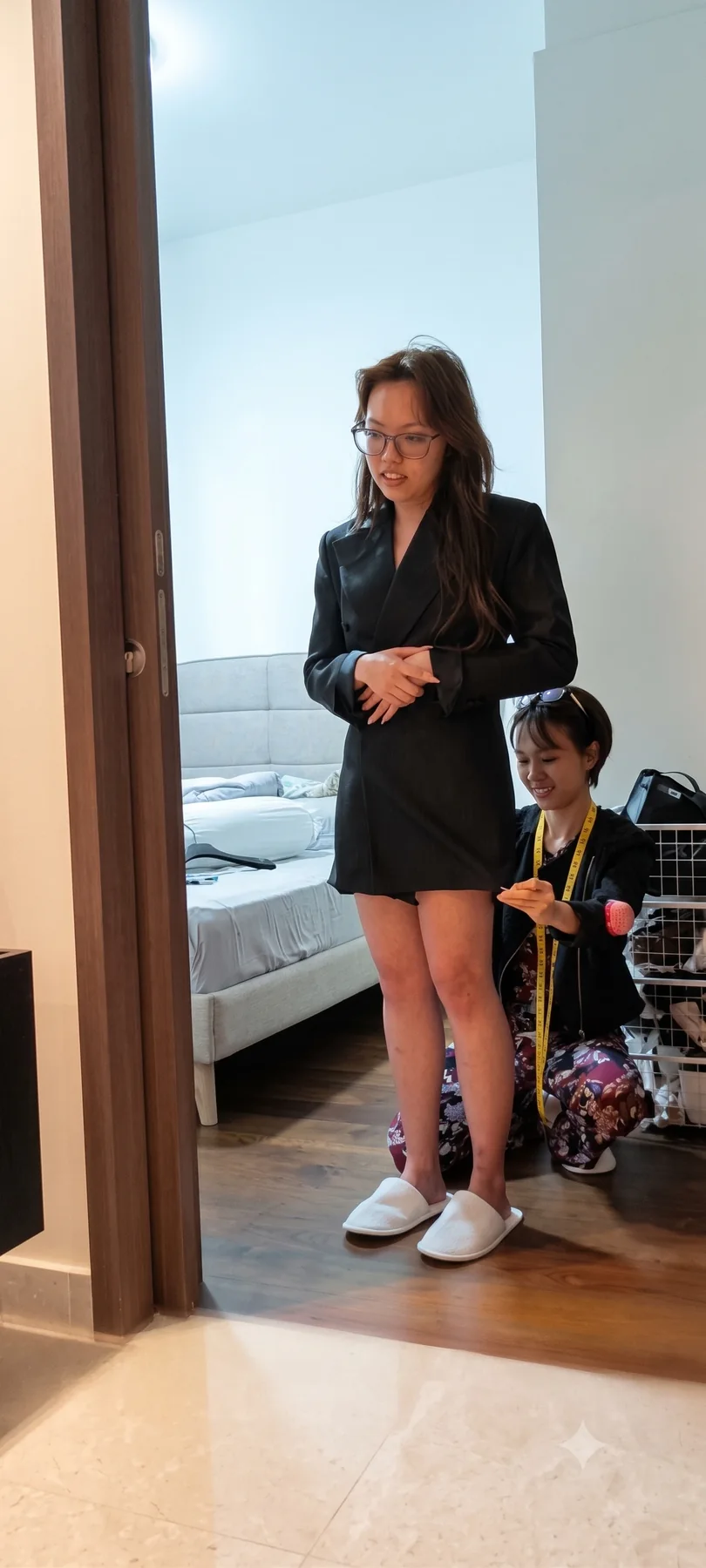
A useful WhatsApp message for a quote usually has three things in it:
- A clear photo of the garment — laid flat or on you, whichever shows the fit problem most clearly.
- Two or three key measurements, using the sections above as a guide for your garment type.
- What you'd like changed, in plain language — "these need to come in about an inch at the waist" is more useful to us than a technical term you're not sure is the right one.
If turnaround matters — an event next week, a trip booked — mention it too. Express alterations run at 1.5x within 5 working days, 2x within 3 days, or 2.5x within 24 hours, subject to an available slot, on top of standard alteration pricing that starts from S$15.80.
How Accurate Does This Need to Be?
Your self-measurement gets the conversation started. The tape measure at your fitting, with the garment on your body and pins in place, is always the one that decides the work.
Close is genuinely good enough for a first estimate — our terms allow for a manual measurement tolerance of up to 1cm, and every alteration is confirmed on your body before any cutting or sewing begins. A quote from a WhatsApp photo and a couple of numbers is a starting point, not a locked-in price; the number we work from is always the one taken at the fitting itself.
This is also why online shopping so often goes wrong on fit — a size chart is a stranger's average, not your actual measurements. If you've already ordered something that missed, our guide on clothes that don't fit after an online order covers which fixes are worth doing.
Don't Want to Measure at All?
That's completely fine — bring the garment as it is, and we'll take every measurement that matters in person. For a broader wardrobe review rather than a single garment, The Stitch Edit is a private, in-home consultation where every piece is tried on, pinned and assessed at your own place — no tape measure or WhatsApp photo required.
For everything else, our full price list is on the rates page, and our clothes alteration cost guide breaks down what different alterations typically run.
Stitch & Steam is a by-appointment studio at 126C Canberra Street, Singapore 753126 — 10 minutes from Canberra MRT and one stop from Yishun, with easy reach from Sembawang, Woodlands and Admiralty. Book an appointment or WhatsApp us with a photo and a couple of measurements, and we'll come back with an honest price range before you commit to anything.
Frequently Asked Questions
What measurements do I need to send for an alteration quote in Singapore?
It depends on the garment, but a photo of the item plus two or three key numbers is usually enough for a starting estimate: waist and hip for pants or a skirt, chest and sleeve length for a shirt, or bust, waist and where you'd like a hem to fall for a dress. Send these over WhatsApp with a note on what feels off, and we can give you a rough price range before you book a fitting.
How do I measure my inseam for pants alterations?
Wear the trousers with the shoes you'd actually pair them with, stand naturally, and measure straight down the inside seam from the crotch to where you want the hem to sit. It's much easier with a second person holding the tape, since bending down to read it yourself tends to shift your stance and skew the number. If no one's around, measure a pair of trousers that already fits the way you want instead — lay them flat and measure the inside leg seam directly.
How do I measure my waist and hips at home?
Wrap a soft fabric tape measure around the narrowest part of your natural waist — usually just above the belly button — keeping it level and snug but not pulled tight. For hips, measure around the fullest part, roughly 20cm below the waist for most people. Keep the tape parallel to the floor all the way around; a tape that dips at the back is the most common reason a self-measurement comes in off.
How do I measure sleeve length for a shirt?
With your arm relaxed at your side and slightly bent at the elbow, measure from the shirt's shoulder seam, over the elbow, down to the wrist bone. If that's awkward to do on yourself, measuring an existing shirt that fits the way you want — flat, from shoulder seam to cuff edge — gives the same number with far less guesswork.
Do I need to measure myself if I already have a fitting booked?
Not strictly — every alteration at Stitch & Steam is fitted and pinned in person before any work begins, so a self-measurement is never the final word. Sending rough numbers ahead of time just means we can quote you sooner and often prepare for the fitting, rather than starting from zero when you arrive. If you'd rather skip measuring altogether, that's completely fine too — just bring the garment.
How accurate do self-measurements need to be for a quote?
Close is good enough — a quote is an estimate, not a commitment, and our terms allow for a manual measurement tolerance of up to 1cm. The number that actually determines the work and the final price is the one taken on your body at the fitting, with the garment on and pins in place. Self-measurements just get the conversation started faster.
Written by Stitch & Steam
Premium clothing alterations and dry cleaning in Canberra, Singapore. Book your appointment today.